Montessori Child Development Stages, Birth to Three Years

The first essential for the child's development is concentration.
The child who concentrates is immensely happy.
— Maria Montessori, MD

LEARNING TO APPRECIATE THE DEVELOPMENT OF INDEPENDENCE, MOVEMENT, LANGUAGE—AND HAPPINESS— IN THE FIRST YEARS OF LIFE

Some believe that the very young child is not as interesting to observe, to interact with, or to teach, as older children. At the same time research proves that the first three years of life are the most important as far as forming the child's emotional base, intelligence, social skills and many other aspects of being human. What is the answer? We must learn what to look for, how to interact, what is happening in these first few days, weeks, months, and years, and how to protect and nurture the child in this precious formative period of life. To watch for, and protect from interruption, those precious moments of concentration during which the child constructs himself. Our knowledge will lead to greater happiness, of the adult and of the child. On this page you will find links to videos and information to that end.


Susan, I love the videos!!!!  I'm so happy you are on the planet at this point in time. You keep us working, keep us moving forward, keep us grounded!  Thank, you, Thank you. I have already used two of the video clips with my students in the Birth to Six training course in Japan. They are wonderful for use in non-English speaking areas as no language is needed to convey the message. Everyone can make a difference in young children's lives IF they have the knowledge of the simple things needed. Thank you so much for continuing in your ever-changing efforts to spread our message of helping children grow and realize their human potential.

—Judi Orion, AMI (Association Montessori Internationale) Director of Training, 0-3. 0-6 Japan; Director of Training 0-3, Denver, Colorado

— MORE COMMENTS & FEEDBACK BELOW —

—The first Year—

Baby watching the Butterfly Mobile

Link: baby watching the Butterfly Mobile. A variety of mobiles gives the child the opportunity to carry out important work in the first weeks of life that should not be interrupted: VIDEO

Link: source of good Montessori mobiles: MOBILES

Mother and baby "talking" or "singing" together

Link: first communication. When we emulate as closely as we can the sounds an infant makes, he or she knows what it feels like to communicate verbally with others. Over use of pacifiers can prevent this important stage of development: VIDEO

Link: from Scientific American Newborns May Start Honing Their Mother Tongue With Their First Cries: ARTICLE

In the first days and months of life the child is intensely interested in watching and looking. At first his ability to focus is the distance between his eyes and the mother's face during nursing. Soon he is interested in watching mobiles that move gently in the wind. Mobiles should have no more than 5 objects and they should be real, such as butterflies, birds, or fish—things that move through the air or water. (2.5 months)

When the older children and adults exactly mimic the baby's first attempts at making verbal sounds, a beautiful conversation, or song, can occur. Here the mother and baby are talking/singing to each other at the changing table. Using the kind of pacifier or gum soother that stays in the mouth and does not have to be held there, can cause an addiction and prevent this wonderful stage of human communication from occurring. (2.5 months)


A makeshift visual "mobile" for the baby
Link: baby watching and reaching for a makeshift "mobile": VIDEO

Link: objects the provide for the reaching and touching stage of development:
TOYS FOR REACHING
Trying to reach a ball
Link: silent video of baby reaching for the ball, which encourages natural efforts to crawl: VIDEO

Link:
toys that support this stage of development:
TOYS FOR CRAWLING
The This baby was visiting a home where there were no visual mobiles and he needed to carry out this important daily "work". So the mother hung a scarf over a lampshade in front of an open window, creating a moving object for the baby to focus on. Suddenly she realized that it seemed he was ready to move beyond watching, to touch! He tried with his whole body to reach the fringe of the scarf. (2.5 months) This child has exercised daily on his tummy from the first weeks of life, strengthening his muscles. Now, given a ball that moves slowly, he is inspired to take the next step. He is learning to slither forward on his tummy trying to reach the ball. Soon he will have the muscular control to crawl, then pull, up and finally to stand and walk—just like the other humans he has been observing. (4-5 months)
Jan crawling

Link: rocking, crawling, moving out into his world all by himself: VIDEO

Link: furniture links for this stage of independence:
FLOOR BED
and other FURNITURE

MORE FIRST YEAR INFORMATION

ARTICLE: Baby Einstein, Not So Smart After all: article on Baby Einstein Videos: Einstein Videos

WEANING: An interesting article written by Susan Stephenson, and a fellow Assistants to Infancy (Birth to Three) teacher. This is a PDF file: weaning

TOILET LEARNING: In the Montessori 0-3 program children are not "trained" to use the toilet, but they are taught the natural steps. An article by a Birth to Three teacher in Amsterdam: toilet learning

BIRTH TO THREE MATERIALS: for the home or infant community: materials


SHARING THIS PAGE

Children all over the world exhibit the same stages of development when they have an environment that supports them. A mattress on the floor, freedom to move and explore in a very safe place. This little Polish boy shows us the whole body rocking stage that precedes crawling, the balance and confidence to develop the abilities to get off of his floor bed, and no doubt the excitement to move from the bedroom to the wider world of the rest of the home.

Please feel free to link this page to your school website, training center website, or any other educational site for parents or students.You may share any of this text, or the pictures or videos, as long as it is for the purpose of educating young people or adults, or helping children. Please credit "With permission of http://www.thejoyfulchild.us"


—One to Three Years—

MORE COMMENTS & FEEDBACK
First table and chairs

Link: Setting up a Montessori home:
HOME VIDEO #1
HOME VIDEO #2

Link: To order a copy of The Joyful Child, recommended in these videos, click here:
THE JOYFUL CHILD

Note: The illustration to the left is from our daughter's kitchen years ago—first table, first chairs for her children, and bench for an adult to join them at their meals. TABLE
(Children's outside furniture visible through the widow)

I used these video clips in my talk with our 0 to 3 parents Thursday night, and they loved them. Lots of "ooh's" and "aah's."  I think this group of parents in particular could really relate to the developmental "miracles" they were seeing, because they are going through these stages right now with their own children. The 2.5 month old "working on reaching for the scarf" illustrates the beginnings of this urge to reach and grasp, and it is perfect because it shows how the child is using every fiber of his being (not just the arm and hand), in this very intense work. His whole body is vibrating, and the emotion he is expressing is joy!

One of the moms had her 3-month old with her at the meeting, and at the end of my talk, just as I concluded, she let out a lovely happy gurgle, just like the video. The perfect exclamation point to the evening!
—Mary Caroline Parker, AMI board member, JD, school administrator, author of The Joyous Observer: Montessori, Parent Education and Human Development

This site really is fantastic, I am going to mail it to everyone. Thank you!
—Heidi Philippart, 0-3 Montessori teacher and school administrator, Amsterdam, HOLLAND

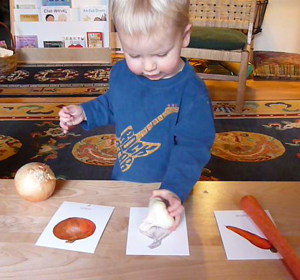
Above are two charming YouTube videos created by a young mother who used the principles, and materials, described in The Joyful Child, (by Susan Stephenson) such as floor bed, small table and chair, small silverware, apron, even the vegetable cards made from paintings by Susan Stephenson, hung at the child's level in the kitchen as art work and vocabulary lessons. She has created a home environment that supports her child's independence, wisdom, and optimum development. We applaud her efforts.

Susan these are breathtakingly beautiful and a blessing to be widely seen!  
Your videography and your writing—I've just read your most recent catalog—
are flourishing.  It's very exciting.

—Karin Salzmann, founding director of AMI/USA
(The Association Montessori Internationale of the United States of America)

floor washing in Bhutan Link: Paro, Bhutan. Resa is included in all the the family work without question, even at 20 months. For a video of her washing the floor see: VIDEO

To see an article about her life, see BHUTAN BIRTH-3

I just can't find the words to say how inspiring this latest Birth to Three message is that you have posted. These videos should be required viewing for Montessori training courses. Many children will have a better "growing up" time thanks to you. Bless you, thank you, you make my heart sing!!!  It has been and is such an honor to be one of your many, many friends.
—Charlene Trochta, member of the AMI Advisory Council, and founding director of Casa Montessori Child Development Center in Austin, Texas, USA


Dear Susan, All of our staff watched the clips and were truly touched by them: I can hardly find words to describe the wonders of seeing a small baby having such a productive communication with his mother. It makes my heart melt and sing! Studying your website and catalogues as well as purchasing some of the products helped me shape my understanding of the 0-3 approach and curriculum when starting the school! We did a translation in Russian and distribute the information in both languages. I also quote you a lot when talking to parents and teachers.

—Valentina Zaytseva, Head of Moscow Montessori Preschool, RUSSIA
,

While Susan was interviewing the mother, aunt, grandmother, of Resa in Bhutan, someone spilled water. The older sister brought a cloth in from the kitchen to clean it up and Resa reached for it. The she began to clean up the spill. Realizing that I was taking a picture with my still digital camera the mother told Resa to look up at the camera. Resa said "No, I will not look up!" The adults appreciated that fact that their including children in the everyday activities of the family is something valued in Montessori education. See the BHUTAN BIRTH-3 link above for more pictures and text that were a result of this interview.

Dear Susan, The videos are so fantastic. Thank you so much for sharing them with us. I will use them both for parents conferences and in the birth preparation class. Thank you for being there to make such big differences in children's lives.
—Nertila Hoxha, Infant Community teacher at the International Montessori School, ALBANIA

socks

Link: child in Montessori 0-3 class in Japan, learning to put on and take off socks. She continued working on this for 45 minutes: REPETITION VIDEO

Your videos show, in a way that words cannot, the importance of living in the moment, cherishing precious time spent with your children, and viewing your children with wonder. It is a profound lesson for all parents. It is a lesson we must not only learn, but relearn, again and again. These children are all concentrating and loving every second of it (and "immensely happy" doesn't necessarily mean a lot of smiling faces). To talk about concentration is one thing, but to see intense concentration is quite another. Concentration is about squeezing every drop out of "now."
—Trevor Eissler, Montessori parent, pilot, author of Montessori Madness


—Growing Up—

A child first learns to UNDRESS and practices undressing over and over again. Eventually, in his own time he will learn to DRESS himself. One of the greatest gifts we can give at this stage is to not interrupt the child's important work, and to manage to give him time. Time for the child to carry out each new skill as many times as possible. Repetition is the key to the child's development and only the child knows how many times he needs to do this with each attempt. The video shows a little girl (19 months) in an Infant Community connected with the AMI teacher training course for birth to three: 0-3 course


MORE BIRTH TO THREE YEARS INFORMATION

Click here for the main birth to three page, The Joyful Child, which contains all 18 chapters of the Montessori Assistants to Infancy (birth to three) overview, and ideas for materials, toys, furniture for children at this age and their parents. It is also a catalogue of mobiles, toys, books, and other materials to order: Joyful Child

Severn Culllis-Suzuki, age 12 Link: 12-year-old Montessori student speaking at The Earth Summit in Rio de Janeiro. SEVERN

GENERAL MONTESSORI INFORMATION

The main Michael Olaf page has very interesting information about Montessori in general: www.michaelolaf.net

ADOLESCENTS LEARNING ABOUT PARENTING

The Montessori 0-3 information is part of the Human Development curriculum for a Montessori Middle school: Human Development Course

When a child is loved and respected for who she is from birth, instead of being trained and pruned to what adults think she should be, there is no limit to the kind of compassionate, creative, problem-solving adult will result.

Severn Cullis-Suzuki was born in Vancouver, Canada, where she attended a Montessori school. At the age of nine, she founded the Environmental Children's Organization (ECO), a group of children dedicated to learning and teaching other youngsters about environmental issues, and in 1992, at the age of 12, raised money with members of ECO, to attend the Earth Summit in Rio de Janeiro, where she was applauded for delivering the above speech to the delegates. This video has since become known as "The Girl Who Silenced the World for 6 Minutes". more


Bio of the author of this page: Susan